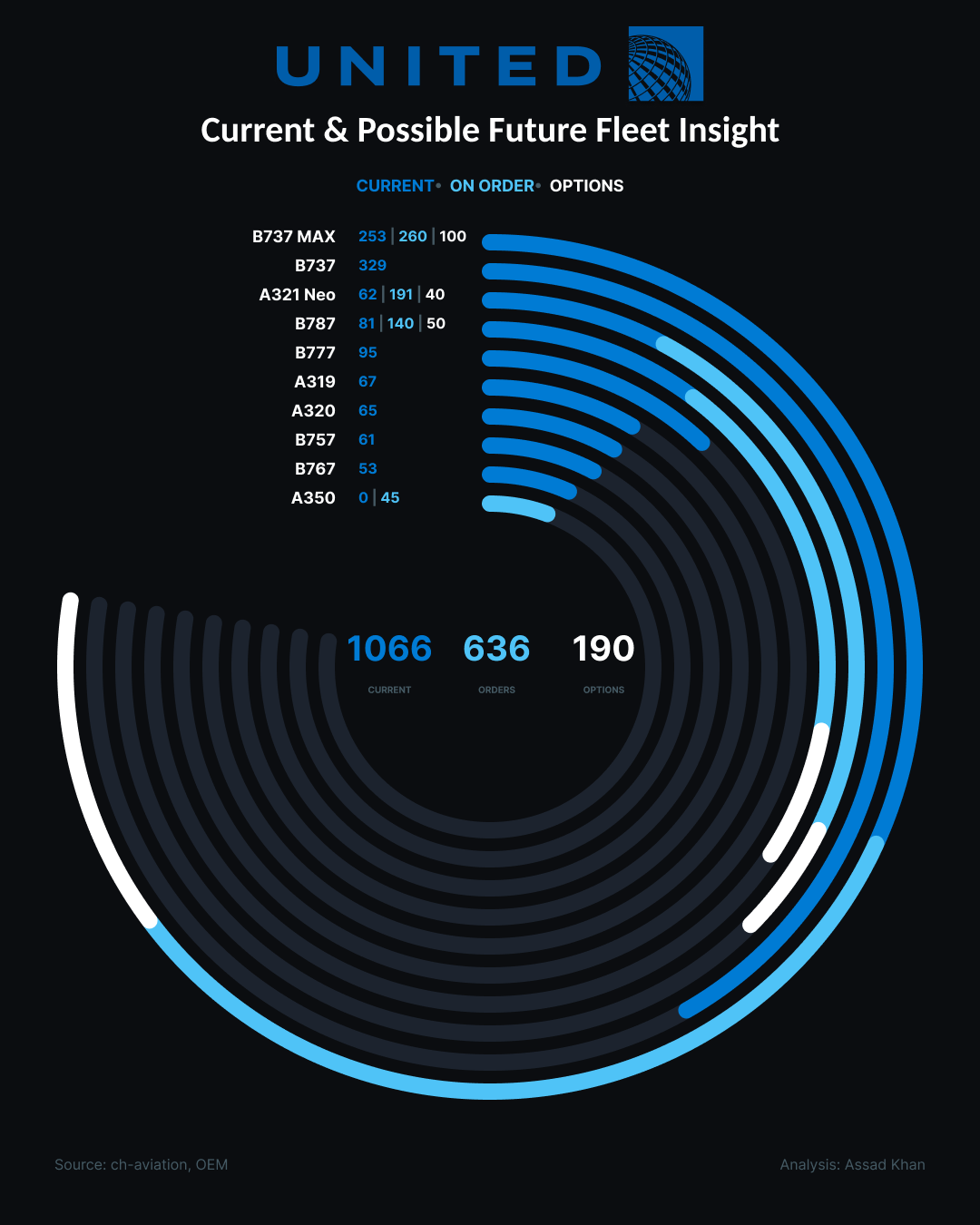
A fleet snapshot shows 1,064 aircraft. The interesting part is the committed future stacked next to it: 638 on firm order and 190 on option. Plot all three per type and the next decade of the world's biggest fleet is one readable chart.
An airline fleet is really three fleets: the one flying today, the one already contracted (deposits paid, delivery slots held), and the one optioned — priced but not promised. Most coverage quotes only the first number. But the strategy lives in the second and third, the way a company's story lives in its commitments, not its cash.
United Airlines fleet composition — current, on order, on option, by type. Open the interactive version → Source: ch-aviation.
Today: a Boeing narrowbody airline
Of the 1,064 current aircraft, the 737 family alone is 580 — 329 classic-generation NGs plus 251 MAXs — more than half the airline. Airbus contributes a 194-strong single-aisle wedge (A319/A320/A321neo), and the widebody fleet stacks 95 777s, 81 787s, and the last 114 of the old guard: 61 757s and 53 767s, the fleet's average-age problem in two bars.
Tomorrow: two waves and a first
The order book is enormous even against that base: 638 firm — 260 more MAXs, 193 A321neos, 140 787s and 45 A350s — plus 190 options. Read it as three moves at once. The MAX wave continues the Boeing narrowbody core. The A321neo wave (62 today, 193 committed) triples the Airbus wedge and takes direct aim at the 757's transcon and thin-Atlantic missions — the same aircraft whose market value keeps appreciating. And the 45 A350s are the airline's first — a widebody hedge sitting behind the 140-strong 787 programme that retires the 767. Committed future without options: 1,702 aircraft.
Why the chart is built the way it is
The classic fleet-table fails because the three statuses get three separate columns and the eye can't add them. Here each type is one bar segmented by status — current solid, orders and options visually lighter — so "what this type becomes" is a single glance: the 737 MAX segment nearly half committed future, the A350 bar with no solid base at all, the 757/767 bars with none. Types sort by total future size, hover gives exact counts, and the palette stays disciplined: status is the encoding, not decoration. It's the same HUD language as the MRO ranking — one format, reused where it fits.
What your data needs to look like
One row per category, with a column for each state you're tracking — here: in service, on order, options.
aircraft_type
in_service
on_order
options
737 MAX
1,064
638
190
A321neo
0
120
60
Novice tip: lay the states out as columns and the agent stacks them into concentric arcs per category. Bring the counts as they stand — it computes the totals and the shares.
The takeaway
United's chart shows an airline running the world's largest fleet — the crown it took in the five-year fleet race — while simultaneously committing to rebuild 60% of it. Half the airline stays 737; the A321neo becomes the second spine; the 787 and a first-ever A350 order sunset the 757/767 era. One chart, and you've read the next decade of network planning.
Have a plan — fleet, headcount, capacity, budget — that lives in current/committed/optional states? Drop it into the AK.VIZ agent for three proposals on your real numbers, or see the portfolio and services.